- Nov 18, 2025
2026 Is the Year of Agentic Engineering — The AI Skills Gap Enterprises Can’t Ignore
2026 Is the Year of Agentic Engineering — The AI Skills Gap Enterprises Can’t Ignore
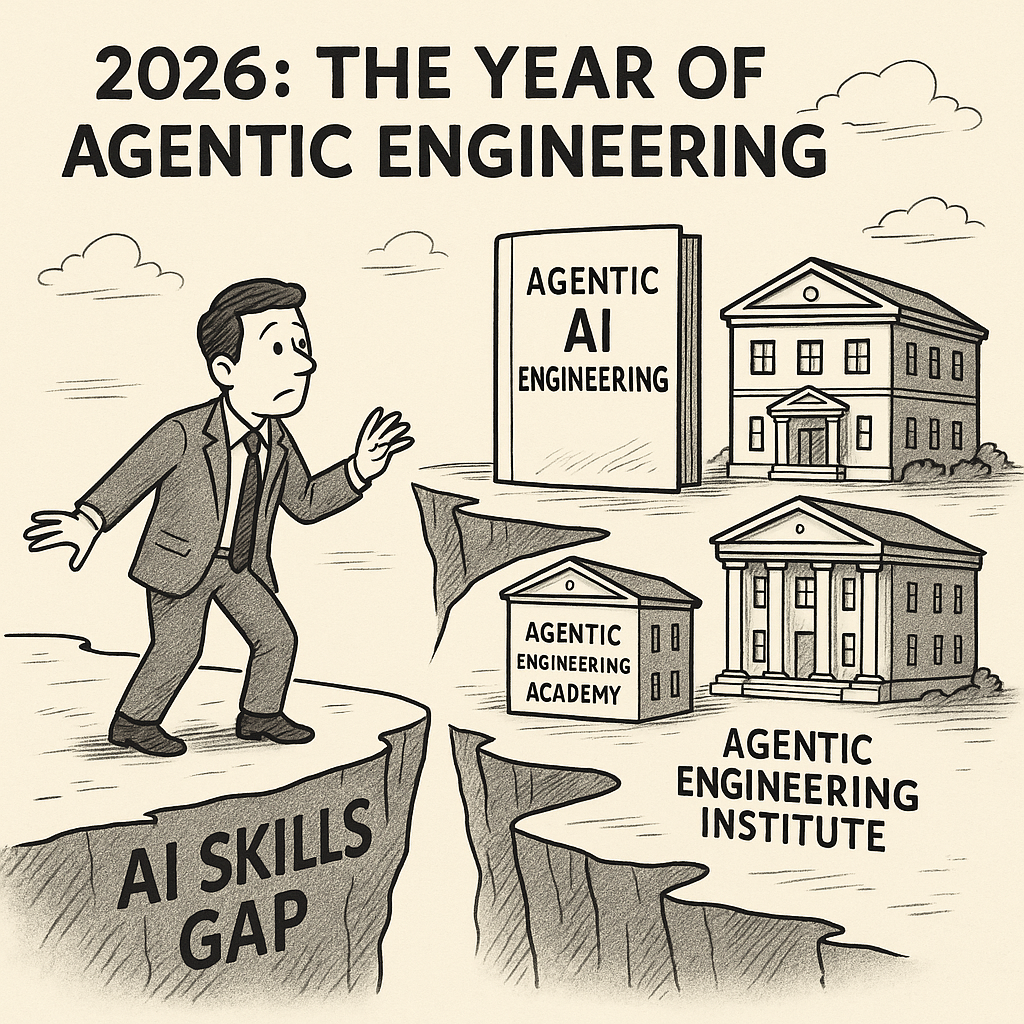
The Skills Gap Has Shifted
Last quarter, a Fortune 500 CIO pulled me aside after a strategy session.
“We don’t need another copilot demo,” she said. “We need agents we can trust in production.”
That single sentence captured the pivot every enterprise leader is now feeling.
For two years, the world was intoxicated by generative AI. Chatbots dazzled, copilots wowed in demos, and executives scrambled to bolt foundation models into their products. The hype was loud, the adoption charts looked steep, but reality soon crept in: most pilots never made it past the sandbox.
Why? Because the skills gap shifted under our feet.
The challenge is no longer about hiring prompt engineers or model fine-tuners. It’s about building production-grade agentic systems that don’t collapse when real-world complexity hits. Systems that can reason, adapt, and recover — not just output fluent text.
In other words: AI isn’t taking your job. But the lack of people who know how to engineer agents at enterprise scale? That could take down your transformation agenda.
Takeaway: The global AI skills gap has entered a new phase. 2026 isn’t just another year of AI adoption. It’s the breakout year of Agentic Engineering — the discipline enterprises can’t afford to ignore.
The Five Signals of an Exploding AI Skills Gap
The evidence is overwhelming. Across industries and geographies, the AI skills shortage has widened into the steepest talent gap in technology. Five signals stand out:
AI skills have overtaken cybersecurity and big data. CIO Dive reports that more than half of IT leaders now face AI talent shortages, up from just 28% in 2023. This is the steepest two-year rise in the 16-year history of its survey. For the first time, AI skills are harder to find than cybersecurity or big data talent.
Training is not keeping up. Randstad found that while 75% of companies are adopting AI, only 35% of employees received AI training last year. The distribution is uneven: 71% of AI-skilled workers are men, and only 22% of Baby Boomers have been offered training.
Enterprises can’t measure what they have. MIT Sloan research shows most organizations don’t even know what skills their employees already possess. Companies like Johnson & Johnson are experimenting with AI-driven “skills inference” to map current and future needs, but most remain blind to the gap.
The gap multiplies inequality. IEEE describes the skills shortage as a “hidden multiplier.” Developing countries often remain stuck at the low-value end of the AI supply chain while economic and innovation gains concentrate in a handful of firms and nations.
The ROI of AI remains elusive. Computerworld highlights that demand for AI talent outpaces supply by two to four times. More than two-thirds of enterprises experimenting with AI have yet to see measurable ROI. The missing link isn’t technology. It’s talent.
The pattern is clear. The skills gap is dynamic. Each wave of technology reshaped it — big data, cloud, cybersecurity, generative AI. Now, agentic AI is the next frontier, and the gap has shifted again.
The biggest AI skills shortage in 2026 is not prompt design or model tuning. It is Agentic Engineering — the discipline of designing, governing, and operating AI agents that survive in production.
Why This Gap Is Different: Agents Are Not Apps
One of the most dangerous misconceptions I see in boardrooms is the assumption that AI agents are just another kind of app. They aren’t. The difference is not cosmetic. It is architectural.
Think of a vending machine versus a junior analyst. A vending machine is deterministic: press a button, get the same snack every time. If the machine jams, the failure is obvious. That’s how apps behave. They follow scripts, execute the same way every time, and fail loudly in ways engineers can quickly diagnose and patch.
Agents, on the other hand, are cognitive systems. They behave more like junior analysts: interpreting instructions, consulting resources, making assumptions, and delivering polished answers. But sometimes those answers are confidently wrong. The danger is not the output itself but the reasoning that produced it — often hidden, inconsistent, or silently flawed.
Consider the difference when things go wrong. If a pricing API fails in a traditional app, developers can fix the integration and redeploy in hours. It’s like swapping out a broken vending machine part. But if a financial analysis agent confuses transaction histories and approves the wrong loan, the problem isn’t a line of code. It’s a flaw in how reasoning, memory, and governance were designed. You can’t patch cognition. You must engineer it from the start.
We’ve already seen the consequences:
A customer service agent that skipped allergy checks while still producing seemingly correct responses.
A remediation agent that retried a failing API call endlessly, racking up runaway cloud bills.
A legal assistant that flagged a “critical risk clause” that didn’t exist, almost tricking senior counsel into signing off.
These aren’t bugs. They are symptoms of a deeper truth: agents are not SaaS products. They are living systems of cognition. And if we want them to survive in production, they demand a new discipline.
2026: The Breakout Year of Agentic AI
Every wave of technology has a tipping point. For cloud, it was when enterprises realized data centers were a liability. For DevOps, it was when release cycles shrank from months to days. For AI, the tipping point is happening now: enterprises are discovering that copilots and chatbots are not enough.
Generative AI dazzled in 2023 and 2024. By 2025, nearly every Fortune 500 had a pilot in play. But pilots don’t pay the bills. And by the end of last year, a sobering pattern emerged: most of those shiny demos had stalled at the edge of production. They worked in the sandbox. They broke in the wild.
Three converging forces are making 2026 the breakout year for Agentic AI.
First, demand has shifted from novelty to necessity. Enterprises are no longer satisfied with copilots that draft emails or summarize meetings. They want agents that can navigate compliance reviews, resolve customer claims, optimize logistics flows, and act as trusted collaborators inside mission-critical processes.
Second, adoption has outpaced capability. Organizations have raced ahead with pilots, but most remain stuck at Level 1 of the Agentic AI Maturity Ladder I describe in Agentic AI Engineering. They can build prototypes, but they cannot yet scale reasoning systems with confidence, governance, and resilience.
Third, enterprises are realizing that the existing toolkits — traditional software engineering, DevOps, even data science — aren’t enough. Agents are not apps, and they cannot be managed as such. The skills needed to design, operate, and govern them don’t fit into any current profession.
That realization is the real inflection point. 2026 isn’t just another year of AI adoption. It is the year enterprises will recognize that building production-grade agentic systems requires a new professional discipline. And that discipline is Agentic Engineering.
The Missing Discipline I Named: Agentic Engineering
When I began outlining Agentic AI Engineering, some told me it was too early. The industry was still intoxicated by generative AI, and few were ready to admit that copilots alone could not scale. But I had already seen the fault lines. Agents were failing not because models were weak, but because enterprises were trying to build them with the wrong blueprint.
I called out what was missing: a discipline as foundational as software engineering, but designed for cognitive systems. That discipline is Agentic Engineering.
The book codified it for the first time.
24 chapters, 578 pages, and 19 practice areas across what I call the Agentic Stack — from cognition, memory, and orchestration to governance, AgentOps, and economics.
Design patterns for structuring reasoning loops, managing context, and scaling multi-agent systems.
Field lessons and anti-patterns drawn from real-world failures — hallucinated legal briefs, silent compliance skips, runaway retry loops that cost six figures in cloud spend.
Best practices for regulated industries where trust, auditability, and compliance are existential.
Even code examples so teams can move from concept to implementation with confidence.
This was not an abstract manifesto. It was the first field manual for a profession that didn’t yet have a name. And now, just a year later, enterprises are proving the point: the biggest AI skills gap of 2026 is not in prompt design, not in model tuning, but in Agentic Engineering — the ability to design, govern, and operate agents that can survive in production.
I didn’t just predict the gap. I named the discipline to close it.
From Academy to Institute: Scaling to Meet Enterprise Demand
When Agentic AI Engineering was published, the response was immediate: enterprises didn’t just want to read about the discipline — they wanted to build it into their organizations. That’s why I founded the Agentic Engineering Academy in 2025: to equip leaders, architects, and practitioners with the skills to design, govern, and operate production-grade agentic systems.
The demand was overwhelming.
Fortune 500 companies came forward, looking for a systematic way to move beyond demos.
Regulated industries asked how to build trust fabrics and audit-ready governance into their cognitive systems.
Startups realized they needed architecture and discipline, not just speed, if they wanted to compete with incumbents.
The message was clear: enterprises don’t need one-off workshops. They need pipelines of talent — engineers fluent in reasoning loops, architects who can design memory and orchestration layers, and leaders who can scale multi-agent ecosystems responsibly.
That is why the Academy is now scaling into the Agentic Engineering Institute (AEI). AEI will be the first dedicated hub for this new profession: a place to train the next generation of agentic engineers, certify their capabilities, and connect them with the enterprises who need them most. The Institute is currently in an invite-only early stage and will officially launch to the public in January 2026.
The skills gap is no longer theoretical. The market has validated it. And 2026 is the year we meet it head-on by building the workforce of the future.
Closing the Next Great AI Skills Gap Now
The evidence is clear. The global AI skills gap has shifted. What enterprises lack most in 2026 is not prompt engineers, not data scientists, and not app developers. It is Agentic Engineers — professionals trained to design, govern, and operate cognitive systems that can be trusted in production.
The path forward starts now.
Read Agentic AI Engineering to understand the field manual for this new discipline.
Prepare for the launch of the Agentic Engineering Institute (AEI) in January 2026, which will scale pipelines of certified talent to meet surging global demand.
If you’re interested in becoming a founding member or participating in the beta before the public release, please contact me directly at yizhou@argolong.com.
The AI skills gap is dynamic, and it will keep shifting as technology evolves. But 2026 is the inflection point. This is the year enterprises will either invest in Agentic Engineering — or risk watching their pilots stall while competitors race ahead.
The future of AI will not be coded.
It will be engineered.
👉 Follow for updates on the launch of the Agentic Engineering Institute (AEI) and explore my book Agentic AI Engineering — the first field manual for this new discipline.
2026 Is the Year of Agentic Engineering — The AI Skills Gap Enterprises Can’t Ignore was originally published in Agentic AI & GenAI Revolution on Medium, where people are continuing the conversation by highlighting and responding to this story.
Free AEI Newsletters
Expert insights and updates on Agentic Engineering—delivered straight to your inbox.