For engineers, architects, and leaders ready to upskill across the full agentic lifecycle.
The Most comprehensive and Deepest Training Available
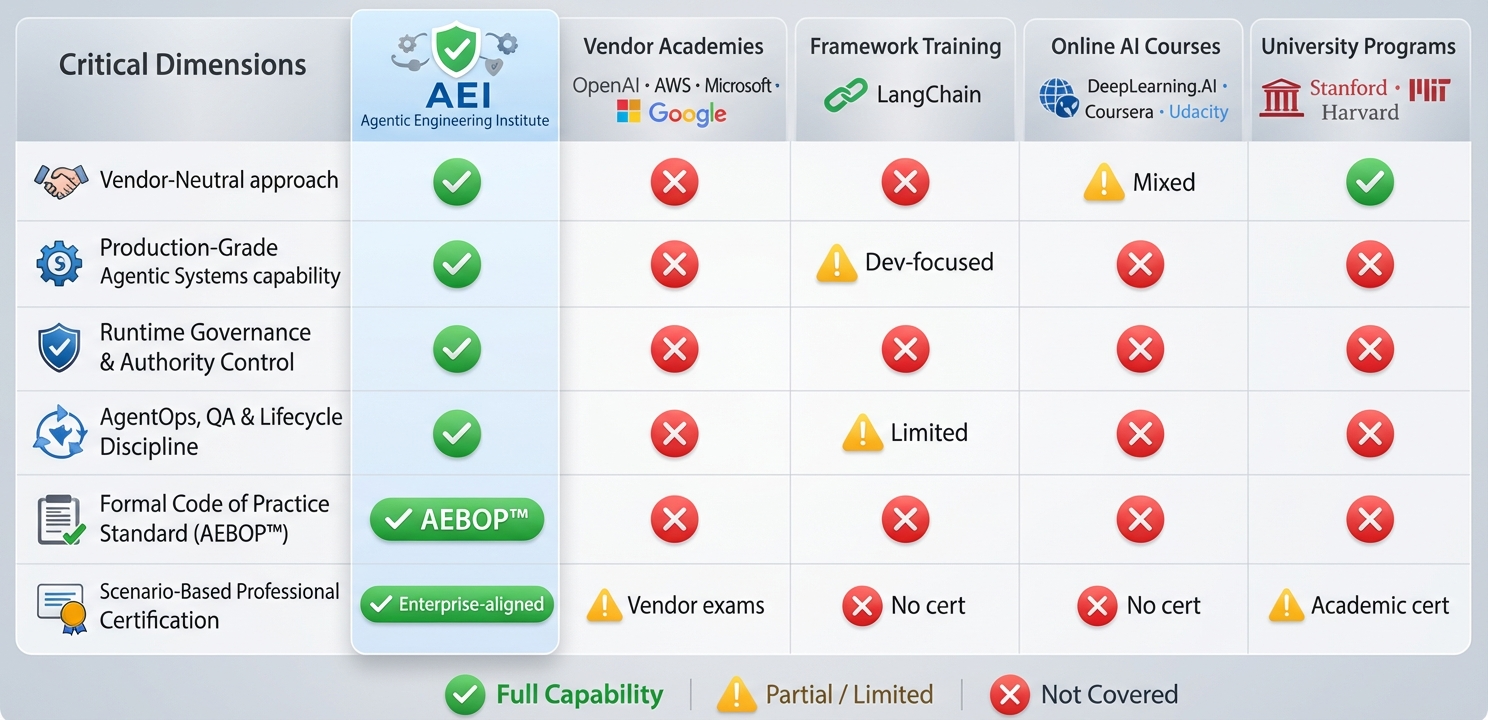
Most AI Training Teaches You How to Build a Demo.
AEI Teaches You How to Build a System That Holds Up in the Real World.
AEI members receive exclusive discounts and more.
Engineers build it. Architects design it. Leaders govern and scale it.
Certification: ✔ CAE Required ✔ CAA Required ✔ CAL Required E Elective Course
1. Agentic Engineering Orientation
2. Agent Runtime Environment (ARE)
3. Agentic Security Engineering
4. Agentic Observability Engineering
5. Agentic Protocol Engineering
6. Agentic Governance Engineering
7. Agentic Knowledge Engineering
8. Agentic Context Engineering
10. Agentic Reasoning Engineering
12. Agentic Orchestration Engineering
15. Agentic Integration Engineering
16. Agentic Cognition Engineering
19. Agentic Quality Assurance (AQA)
21. Agentic Product Management
22. Agentic Team & Organization Design
23. Agentic Maturity Model & Ops
✔
✔
✔
✔
✔
✔
✔
✔
✔
✔
✔
✔
E
E
E
E
E
E
E
E
E
E
E
E
✔
✔
✔
E
E
E
E
E
E
✔
E
✔
✔
✔
✔
✔
✔
✔
E
✔
E
E
E
E
✔
E
✔
✔
E
✔
E
E
E
E
E
E
E
E
E
E
✔
✔
✔
✔
✔
✔
✔
✔
Testimonials
“After graduating, I spent six months applying for AI roles without traction. AEI’s courses helped me move beyond theory and understand how agentic systems operate in production. I secured an AI Agent Developer role shortly after and finally felt job ready.”
“We were close to missing a critical delivery milestone. AEI’s training gave me the system-level patterns and validation approaches to stabilize our agentic pipeline. We met the deadline and avoided a rollback that would have put my role at risk.”
“I had built many AI components, but AEI helped me design agentic systems end-to-end. The architectural clarity changed how I review designs and guide teams. It’s the first training that matched the complexity I deal with daily.”
“Operating agentic AI in production was chaotic before AEI. The courses gave me concrete patterns for monitoring, validation, and failure handling. Incidents dropped, and on-call stopped feeling like guesswork.”
“AEI helped me shift from building features to owning systems. I was promoted to AI Tech Lead and now use AEI frameworks to align engineers and architects. I’m pursuing AEI certifications to formalize what we’ve put into practice.”
“What stood out was the focus on lifecycle and control. AEI gave us a shared language across engineering, architecture, and leadership. That alignment accelerated decisions and reduced friction across teams.”