- May 18
Forward Deployed Engineer: The New $200K+ AI Role Built for the Enterprise AI Adoption Era
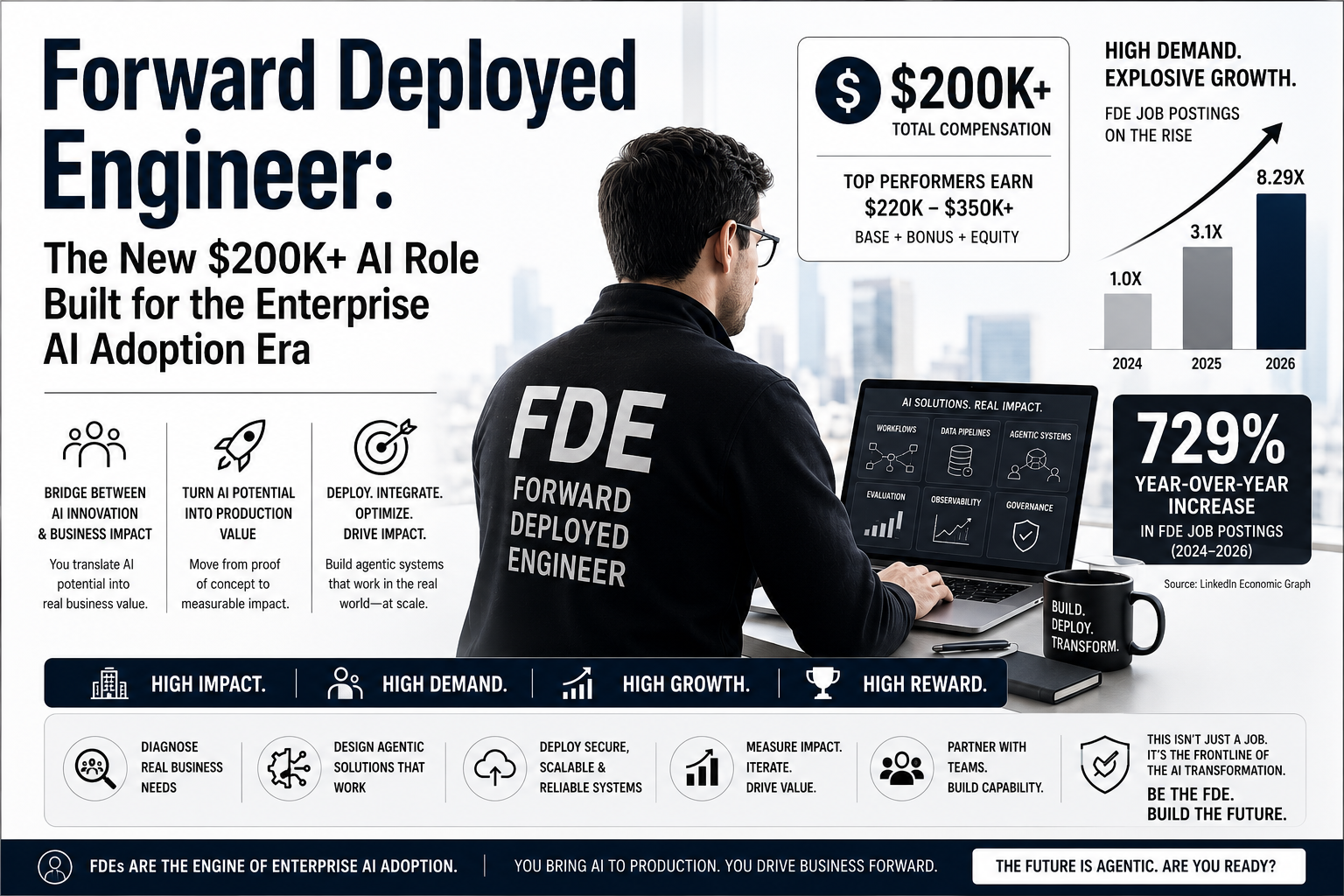
AI is compressing parts of the technology workforce, but it is also creating a premium class of professionals for the work AI cannot do by itself: turning powerful models into production systems that actually change how enterprises operate. That is why one of the fastest-rising roles in the AI economy is not “prompt engineer,” “AI influencer,” or “model researcher.” It is the Forward Deployed Engineer, or FDE.
The numbers are hard to ignore. In April 2025, there were 643 forward-deployed engineering job postings on Indeed. By April 2026, that number had jumped to 5,330, a 729% year-over-year increase, with reported salaries ranging from roughly $170,000 to more than $200,000. In a market still absorbing layoffs, automation anxiety, and hiring caution, this kind of growth is not just a career trend. It is a signal that the bottleneck in enterprise AI has moved from model access to deployment capability.
The reason is simple: enterprises have already seen the demo. They have run the pilot, tested the chatbot, launched the internal experiment, and briefed the board on AI strategy. What they still struggle to do is turn AI into a governed, measurable, production-grade capability inside real workflows, with real data, real users, real controls, real risk, and real accountability. That is the gap FDEs are being hired to close.
OpenAI’s latest move makes the shift impossible to miss. In May 2026, OpenAI launched the OpenAI Deployment Company to help organizations build and deploy AI systems they can rely on every day. As part of the launch, OpenAI agreed to acquire Tomoro, bringing approximately 150 experienced Forward Deployed Engineers and Deployment Specialists into the company from day one. The message is clear: one of the world’s most important AI companies is not only competing on model capability. It is building an enterprise deployment engine.
That is why the rise of the FDE matters. It is not merely a new job title with attractive compensation. It is the labor-market expression of a deeper shift: enterprise AI is entering the adoption era. The winners will not be the organizations with the most impressive demos. They will be the ones that can engineer AI into workflows, govern its behavior, measure its impact, and scale it beyond heroic one-off deployments.
Welcome to the rise of the Forward Deployed Engineer, and to the beginning of the Agentic Engineering era.
What a Forward Deployed Engineer Actually Does
A Forward Deployed Engineer is not a traditional software engineer with better people skills, and not a solutions engineer with permission to write code. The role exists because enterprise AI breaks the old division of labor. In traditional software, product teams build, sales teams sell, implementation teams configure, and customer success teams drive adoption. In enterprise AI, those boundaries collapse because the hardest problems appear only after the technology touches real workflows.
An FDE works inside that collision zone. They sit close enough to the customer to understand the real operating problem, but remain technical enough to design and build the system that solves it. In practice, the role follows a deployment loop:
Diagnose the workflow
Understand how the customer actually works, where decisions happen, where handoffs break, where latency accumulates, and where AI could create measurable value.Design the system
Translate messy business reality into architecture: data flows, model behavior, tool access, human review, security boundaries, evaluation criteria, and rollout strategy.Build the bridge
Write code, create integrations, connect systems, configure workflows, and make the AI capability usable inside the customer’s operating environment.Validate the outcome
Test whether the system works across real use cases, edge cases, policy constraints, user behavior, and business success metrics.Feed the field back into the product
Turn deployment lessons into reusable patterns, product improvements, model feedback, evaluation methods, and stronger implementation playbooks.
That operating loop is what makes the FDE different. A software engineer can build a feature. A consultant can recommend a transformation. A solutions engineer can explain how the product fits. A customer success manager can drive usage. But an FDE is accountable for the harder outcome:
making the system work in production, inside the customer’s environment, under the customer’s constraints, with enough evidence that the deployment can expand.
OpenAI’s own FDE descriptions make this shift explicit. The role owns discovery, technical scoping, system design, build, and production rollout, while measuring success through production adoption, workflow impact, and feedback that shapes product and model roadmaps. That is not post-sales support. It is enterprise AI adoption engineering.
This is why the best FDEs are not just technical generalists. They are deployment engineers. They understand that the real failure mode in enterprise AI is rarely that the model cannot produce an impressive answer. The failure usually appears in the surrounding system: the workflow was misunderstood, the data boundary was unclear, the evaluation was too shallow, the tool permissions were too broad, the human escalation path was missing, or the business process could not absorb the change.
That is what makes FDE such an important role in the AI adoption era. The FDE is not there to make the demo look better. The FDE is there to turn frontier AI capability into working enterprise capability.
Palantir Created the Playbook. AI Made It Mainstream.
The Forward Deployed Engineer did not begin as an AI-era job title. Palantir popularized the modern version through its Forward Deployed Software Engineers, or “Deltas,” who embedded directly with customers to configure Palantir platforms around hard operational problems. Palantir’s own distinction remains the cleanest explanation of the model: traditional software engineers build one capability for many customers; FDSEs enable many capabilities for one customer.
That was the original insight: complex enterprise software often fails when builders are too far from the operating environment. Requirements are incomplete, workflows are political, data is messy, and the real problem rarely looks like the sales deck. Palantir’s answer was to place engineers close enough to the customer’s mission to translate field reality into working systems.
AI makes that model dramatically more important.
With traditional enterprise software, forward deployment was mostly about integration, configuration, data flow, and adoption. With enterprise AI, deployment becomes a behavioral problem. The system may retrieve information, generate recommendations, summarize regulated documents, call tools, trigger workflows, escalate exceptions, or act on behalf of a user. The FDE is no longer just adapting software to a customer environment. The FDE is helping engineer how an intelligent system behaves inside a live enterprise.
This is why OpenAI’s Deployment Company matters. OpenAI says its new company will help organizations build and deploy AI systems they can rely on every day, and its Tomoro acquisition brings approximately 150 experienced Forward Deployed Engineers and Deployment Specialists into that model from day one.
The shift is clear: Palantir proved that complex enterprise software needs customer-embedded engineers. Enterprise AI proves that customer-embedded engineering now needs a deeper discipline: runtime governance, evaluation, observability, trust architecture, and operating-model design.
Palantir created the FDE playbook.
AI turned it into a mainstream enterprise adoption model.
Why FDE Compensation Is Rising
FDE compensation is rising because the role combines three scarce capabilities: production engineering, enterprise judgment, and direct ownership of adoption. Most companies can hire engineers who build, consultants who advise, and customer success teams who support. It is much harder to find someone who can walk into a messy customer environment, diagnose the workflow, build the system, prove the value, and feed the learning back into the product.
The mainstream salary band already reflects that scarcity. Paraform’s 2026 analysis puts median FDE base salary at $173,816, with observed base ranges from $150,000 to $217,000. Founding FDE roles can reach $166,000 to $266,000, while staff and principal FDE roles can reach $190,000 to $288,000 before equity. Paraform also reports that many FDE roles include equity, which can materially change total compensation at AI-native companies.
The high end is even more revealing. Levels.fyi reports Palantir Forward Deployed Software Engineer compensation in the U.S. from $171,000 to $415,000, with a median package of about $215,000. 6figr reports FDE compensation averaging $231,000, mostly ranging from $198,000 to $516,000, with the top 10% above $307,000. Paraform’s hiring guidance for AI companies goes even further, advising startups to expect $350,000 to $550,000 total compensation for top FDE talent.
The premium is not about the title. It is about leverage. A strong FDE can be the difference between an AI deployment that dies after the pilot and one that becomes a production system, expands across business units, and proves measurable workflow impact. In AI-native companies, that makes the FDE part engineer, part deployment strategist, part product feedback loop, and part value-realization engine.
The caveat is important: not every “forward deployed” role is a premium AI role. Some are closer to implementation or professional services. Pay depends on company, seniority, equity, location, customer ownership, and how deeply the role touches production AI systems. But the market signal is clear:
the highest compensation is going to people who can turn AI capability into working enterprise capability.
FDE Is Becoming the Enterprise AI Adoption Model, But It Will Not Scale by Heroics
FDE is no longer just a job title. It is becoming an enterprise AI adoption model.
That shift makes sense. The old enterprise technology playbook was built around selling software: build the product, sell the license, provide documentation, assign implementation support, and expect the customer to absorb the change. That model was imperfect for traditional software. It breaks down with enterprise AI because AI does not simply need installation or configuration. It must be connected to workflows, data, tools, controls, users, evaluation loops, and measurable business outcomes.
This is why forward deployment is becoming so important. Enterprises do not just need access to AI. They need help turning AI into operating capability. A strong FDE can enter a customer environment, find the real workflow bottleneck, design the right AI system, build the bridge into production, prove the value, and feed field learning back into the product. In that sense, the FDE becomes the human deployment layer between frontier AI capability and enterprise adoption.
But this is also where the model exposes its weakness.
Forward deployment works because it brings elite engineering judgment close to the customer. That is powerful, but it is not automatically scalable. If every deployment depends on a few exceptional people improvising in the field, FDE becomes expensive custom consulting. One FDE solves a workflow problem one way. Another solves a similar problem differently. A third leaves behind undocumented assumptions. A fourth creates a clever solution that works for one customer but cannot be reused, governed, or audited.
That is the hidden scalability problem behind the FDE boom.
The market is discovering that forward deployment is necessary. But necessity is not the same as maturity. To scale FDE work, enterprises need shared standards, reusable architectures, evaluation practices, governance patterns, observability models, trust controls, and operating disciplines. Otherwise, the model produces brilliant one-off deployments instead of repeatable enterprise capability.
This is where Agentic Engineering enters.
Agentic Engineering is the emerging discipline for designing, deploying, governing, and operating agentic AI systems in production. It treats AI adoption not as a demo, a prompt, or a one-off implementation project, but as a system-level engineering challenge involving runtime behavior, delegated authority, workflow reliability, evaluation, trust, and governance.
The Agentic Engineering Institute (AEI) exists to professionalize that discipline. Through AEBOP™, the Agentic Engineering Body of Practices, AEI provides the standards, architectural patterns, governance models, and certification pathways needed to turn field deployment into a repeatable enterprise capability.
Forward deployment brings AI closer to the customer.
Agentic Engineering makes that deployment motion repeatable, governable, and production-grade.FDE capacity can win early deployments.
Agentic Engineering standards are what make those deployments scalable.
How to Become a Proficient FDE
The mistake many people make is thinking FDE is simply a hybrid of software engineering and customer communication.
That is only the surface.
A proficient Forward Deployed Engineer can enter an ambiguous enterprise environment, identify where AI can create real value, design the system around that value, deploy it into production, prove that it works, and leave behind a capability that can scale after they are gone.
That is why FDE is becoming one of the clearest gateway roles into Agentic Engineering: the discipline for designing, deploying, governing, and operating agentic AI systems in production.
To become a serious FDE in the enterprise AI era, you need six capabilities.
1. Production engineering depth
FDEs must build real systems, not demos. That means APIs, databases, cloud infrastructure, authentication, data pipelines, workflow integration, security basics, deployment discipline, and debugging under pressure.
In the agentic AI era, this also means deploying systems that retrieve information, reason across context, call tools, trigger workflows, and influence decisions. A chatbot demo is not enough. Production AI requires system engineering.
2. Workflow diagnosis
Weak AI builders start with the model. Strong FDEs start with the work.
They study how decisions are made, where handoffs break, where latency accumulates, where repetitive judgment appears, where compliance risk enters, and where AI can change the economics of the process.
A demo builder sees a use case. A proficient FDE sees the operating system around the use case.
3. Agentic system design
Modern FDE work is increasingly agentic. It is not enough to call an LLM API, build a RAG pipeline, or connect a chatbot to enterprise data.
You need to understand context engineering, retrieval, tool use, orchestration, memory, human-in-the-loop escalation, guardrails, rollback paths, and failure recovery.
The question is not, “Can the model answer?”
The question is, “Can the system complete the workflow reliably, safely, and measurably?”
4. Evaluation and observability
Enterprise AI cannot be governed by vibes.
A proficient FDE defines success criteria, builds evaluation sets, tests edge cases, monitors drift, measures workflow impact, and turns failure patterns into product improvements.
But evaluation alone is not enough. The system also needs observability: what context was used, which tools were called, which policies applied, where uncertainty appeared, and when humans were pulled back into the loop.
5. Runtime governance
Every useful enterprise AI system eventually touches authority. It may access sensitive data, recommend decisions, call tools, trigger workflows, or act on behalf of a user.
That means governance cannot be added after deployment. It has to be engineered into runtime behavior: authorization, auditability, policy enforcement, escalation, reversibility, and accountability.
This is where Agentic Engineering becomes essential. Traditional governance focuses on models and approvals. Agentic systems require governance of actions.
6. Repeatable field judgment
FDEs operate where documentation ends. Requirements change. Stakeholders disagree. Data is messy. The workflow is not what the customer described. The model works in the lab and fails in the field.
A good FDE solves the customer’s problem.
A great FDE turns that solution into a reusable architecture, evaluation method, governance pattern, implementation playbook, or product improvement.
That is the shift from individual heroics to professional discipline.
This is also where AEI fits. The Agentic Engineering Institute helps practitioners move beyond ad hoc AI deployment through AEBOP™, production-grade standards, and certification pathways such as CAE™, CAA™, and CAL™.
The future FDE will not simply be the person who can build fast in the field.
The future FDE will be the person who can turn field complexity into governed, repeatable, production-grade enterprise AI capability.
FDE Is the Gateway Role into Agentic Engineering
The rise of the Forward Deployed Engineer is not just a hiring trend. It is the first visible signal of a larger professional shift.
Enterprise AI is creating a new class of builders:
people who can move intelligent systems from demo to deployment, from model output to workflow impact, from technical possibility to governed operating capability.
That is why FDE matters.
But FDE is not the final form. It is the field-facing gateway into Agentic Engineering, the discipline for designing, deploying, governing, and operating production-grade AI systems that reason, use tools, interact with workflows, and act under enterprise constraints.
This distinction is critical. A strong FDE can help one customer turn AI into value. A strong Agentic Engineer can help an organization build the repeatable capability to do it again and again, across teams, workflows, business units, and risk environments.
That is the gap the Agentic Engineering Institute is built to close: turning ad hoc AI deployment into a professional discipline through AEBOP™, production-grade standards, operating frameworks, and certification pathways.
For individuals, FDE is no longer just a high-paying AI role. It is a career doorway into one of the most important professions of the AI era. If you want to become ready for FDE roles, AEI gives you the foundation: agentic system architecture, runtime governance, evaluation, observability, trust engineering, AgentOps, and production-grade AI operating models.
For enterprises, AI platforms, and consulting firms, the lesson is sharper: hiring a few brilliant FDEs may win early deployments, but scaling AI adoption requires standards, architecture, governance, evaluation, observability, and a professional system for developing deployment-ready talent. If your organization wants to build that capability, partner with AEI.
That is the real meaning of the FDE boom.
Prompt engineers taught people how to talk to AI.
Forward Deployed Engineers teach enterprises how to use AI.
Agentic Engineers teach enterprises how to operate AI safely at scale.
The future of enterprise AI will not belong to the teams with the best demos. It will belong to the teams that can turn intelligence into reliable operating capability.
FDE is the doorway. Agentic Engineering is the profession.
Join AEI to get ready for FDE and Agentic Engineering roles.
Partner with AEI to scale production-grade enterprise AI adoption.
Free AEI Newsletters
Expert insights and updates on Agentic Engineering—delivered straight to your inbox.