- Dec 15, 2025
The First Production AI Agents Study Reveals Why Agentic Engineering Becomes Mandatory in 2026
A data-driven study shows why productivity, reliability, and human-in-the-loop design, not autonomy hype, will define the next phase of Enterprise AI.
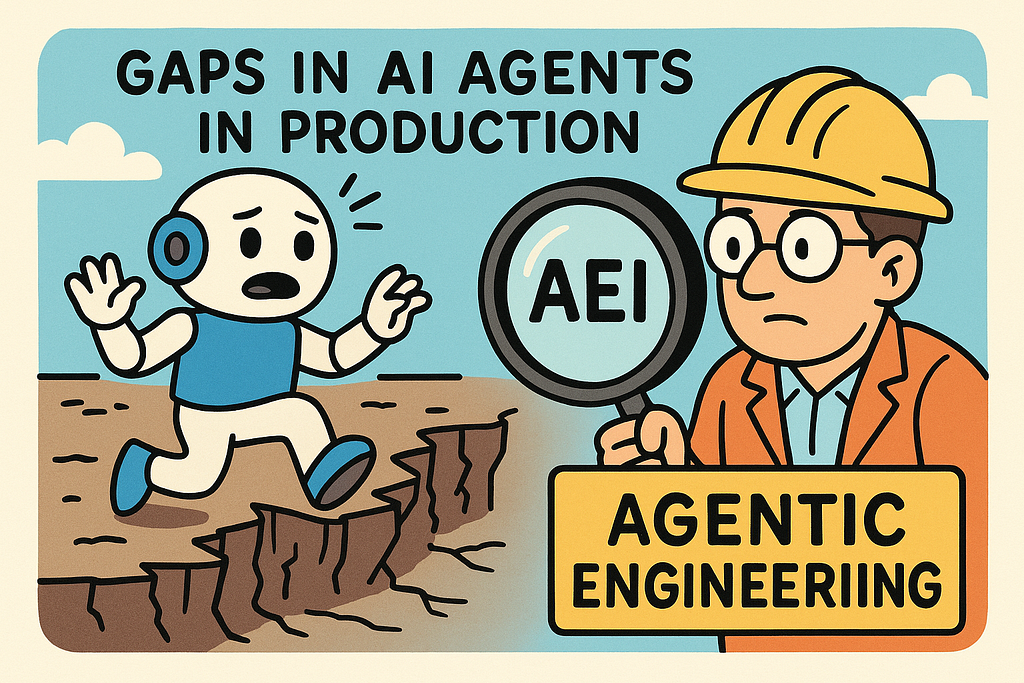
AI agents are no longer theoretical. They are already running inside enterprises, supporting finance teams, healthcare operations, DevOps, customer support, legal workflows, and internal analytics.
Until recently, however, most claims about “agents in production” were based on demos, vendor narratives, or isolated success stories. What was missing was a systematic view of how agents are actually built, evaluated, and operated at scale.
That gap is now closed.
This article is grounded in the first large-scale systematic study of AI agents in production, surveying 306 practitioners and conducting 20 in-depth case studies across 26 domains. The study examines four questions: why organizations build agents, how they build them, how they evaluate them, and what challenges most often block success.
The answers are clarifying, and uncomfortable.
The data cuts through the hype
The study surfaces four facts that matter most.
1. Agents are deployed for productivity, not autonomy
~73% of teams deploy agents primarily to increase productivity and reduce human task time
Risk mitigation and operational stability rank below 20% as primary drivers
Agents survive in production when value is measurable in hours saved and cost reduced, not in abstract potential.
2. Autonomy is deliberately constrained
68% of deployed agents execute 10 or fewer steps before human intervention
Nearly 50% execute 5 or fewer steps
Open-ended autonomy is rare and typically sandboxed
In production, autonomy is treated as a risk surface, not a goal.
3. Humans remain central to evaluation
~74% rely primarily on human-in-the-loop evaluation
~52% use LLM-as-a-judge, always paired with humans
~75% of interviewed teams operate without formal benchmarks
Correctness for real-world agent tasks cannot yet be validated without human judgment.
4. Reliability is the dominant unsolved problem
Practitioners consistently rank reliability and correctness as the top technical challenge
Latency blocks deployment in only a small minority of cases
Engineering decisions are driven by trust and failure containment, not speed.
Bottom line:
Production agents work today because teams compensate with constraints, human oversight, and bespoke engineering. That pattern does not scale.
Why production agents look simpler than expected
Production agents do not resemble research prototypes. The study explains why.
~70% rely on off-the-shelf frontier models, using prompting instead of fine-tuning
Fine-tuning is applied selectively for narrow, high-value subtasks
Prompt construction is largely manual and often extensive
68% follow bounded workflows rather than open-ended planning
85% of in-depth case studies use custom in-house implementations, abandoning frameworks at scale
Each additional autonomous step, model call, or planning loop increases failure probability, latency, cost, and evaluation complexity.
Simplicity is not a lack of ambition. It is an engineering strategy.
The real gap is not intelligence. It is engineering.
The study makes one conclusion unavoidable: model capability is no longer the primary bottleneck.
Frontier models are already “good enough” for many production tasks. That is why most teams rely on off-the-shelf models and focus their effort elsewhere.
What blocks scale is the absence of engineering structure around agents:
Reliability remains unsolved
Evaluation lacks standardized benchmarks
Human judgment is essential but not systematized
Model behavior shifts across upgrades
Traditional CI/CD does not apply cleanly to non-deterministic systems
These are not model problems. They are system problems.
Teams are already solving them informally through constraints, humans, and custom pipelines. But they are doing so without shared standards or a formal discipline.
Why Agentic Engineering becomes mandatory in 2026
2024 and 2025 were about proving AI could work.
2026 is when enterprises demand that AI be reliable, auditable, and accountable.
Budgets tighten. Boards ask harder questions. Regulators pay closer attention. At that point, organizations will discover a hard truth:
You cannot scale AI agents with prompts, hope, and hero engineers.
Agentic Engineering formalizes what production teams are already doing:
Designing bounded autonomy instead of chasing full autonomy
Treating human-in-the-loop as a runtime architecture, not a fallback
Engineering evaluation, verification, and observability for agents
Managing agent lifecycle across model upgrades and deployments
This is how agents become scalable systems rather than fragile pilots.
Where AEI fits
The study makes one point clear: production success today depends on repeatable engineering patterns, not better models. Teams are independently converging on similar solutions, but those solutions remain fragmented, undocumented, and difficult to scale.
This is the gap the Agentic Engineering Institute (AEI) exists to close.
AEI was created to help enterprises and professionals turn AI breakthroughs into practical, high-ROI implementations. Its core asset is the Agentic Engineering Body of Practices (AEBOP), a living, continuously updated field guide that defines how intelligent systems are built, operated, and governed in production.
AEBOP is grounded in reality. It is distilled from 2,000+ pages of field notes across 600+ real-world deployments spanning six industries. These are not theoretical patterns. They reflect lessons learned under real deadlines, real constraints, and real operational risk.
Through AEBOP, AEI provides:
Production-grade best practices and implementation standards
Reference architectures and canonical design patterns
Code examples, templates, and operational checklists
Maturity ladders, playbooks, and documented anti-patterns
Together, these resources formalize what production teams are already doing informally: bounding autonomy, engineering human-in-the-loop verification, designing evaluation pipelines, and enforcing trust and governance.
AEI’s focus is practical advantage: faster systems, lower cost, higher accuracy, and disciplined execution.
As enterprises move into 2026, the question is no longer whether agents can be built. It is whether they can be trusted, governed, and scaled responsibly. AEI and AEBOP exist to make that transition possible.
Final takeaway
The most important insight from this systematic study is not that AI agents are powerful.
It is that AI value today is delivered through disciplined engineering, constrained autonomy, and human-centered system design.
In 2026, the organizations that win will not be those with the most agent demos. They will be the ones that treat agents as engineered systems.
That future has a name.
Agentic Engineering.
The First Production AI Agents Study Reveals Why Agentic Engineering Becomes Mandatory in 2026 was originally published in Agentic AI & GenAI Revolution on Medium, where people are continuing the conversation by highlighting and responding to this story.
Free AEI Newsletters
Expert insights and updates on Agentic Engineering—delivered straight to your inbox.