- Jul 22
LangChain Is Dead? What Serious AI Agent Teams Are Actually Using in July 2026
Research and platform status updated through July 2026.
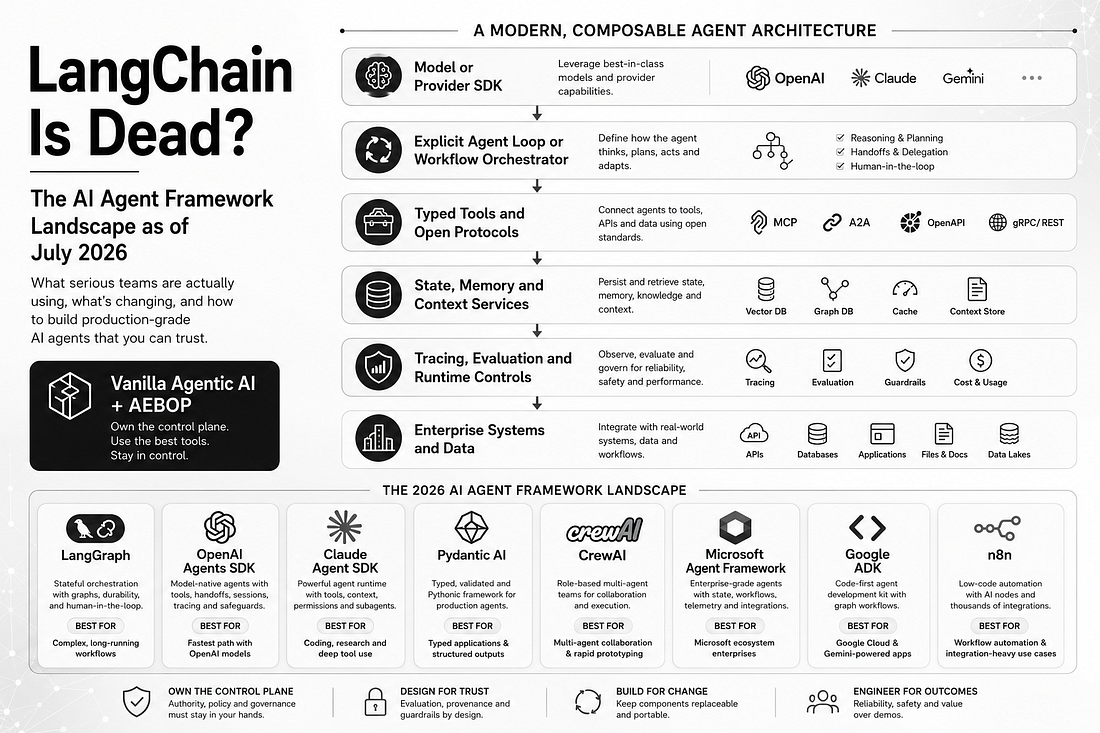
Over the past six months, the same verdict has echoed across developer communities:
LangChain has run its course. LangGraph has become too heavy. The best engineering teams are stripping both from their stacks.
It is a compelling story. It is also wrong.
Not completely wrong — which is why it spreads — but wrong in the way that matters.
LangChain is still one of the most visible AI development projects in the world. Its GitHub repository has roughly 142,000 stars. LangGraph has approximately 38,000, remains under active development, and released version 1.3.14 on July 16, 2026. Developers and enterprises continue to use both.
But the criticism is pointing at something real.
The industry has moved beyond the problem LangChain originally solved.
In 2022, developers needed a convenient abstraction over model APIs, prompts, retrieval, embeddings, vector stores, and tool calls. By 2026, the harder problems are state, authority, recovery, evaluation, memory governance, runtime security, cross-agent provenance, and production control.
The framework is no longer the center of the architecture.
And many teams are learning that the hard way.
The Octomind story became a warning for an entire industry
Octomind published one of the most widely circulated critiques of LangChain.
The company was using agents for serious software-testing work: test-case discovery, Playwright test generation, and automatic test repair. LangChain initially accelerated development. But as Octomind moved from a simple sequential agent toward subagents, specialist collaboration, and dynamically assigned tools, the abstraction became an obstacle.
The team found itself translating product requirements into “LangChain-appropriate” solutions, debugging framework internals, and reading stack traces generated by layers of abstractions it did not own.
After removing LangChain, the team summarized the result in five words:
“We could just code.”
That story resonated because many developers had experienced the same pattern.
A framework helps enormously when your problem resembles the framework designer’s assumptions.
It becomes expensive when your product begins to diverge from them.
But there is a critical nuance that often disappears from the retelling:
Octomind’s experience was primarily a critique of early LangChain abstractions — not proof that all orchestration frameworks are unnecessary.
In fact, the industry’s response to many early LangChain limitations was LangGraph: lower-level, explicit, stateful orchestration with checkpoints, cycles, durable execution, and human intervention.
The lesson was not “never use frameworks”.
It was:
Do not let a framework hide the parts of your system that you most need to understand and control.
How we got here: four generations of agent development
The framework debate makes more sense when viewed as an evolution rather than a horse race.
Generation 1: Chains and integrations, 2022–2023
LangChain released its first Python package in October 2022.
At the time, developers were repeatedly rebuilding the same plumbing:
Prompt templates
Model wrappers
Document loaders
Retrieval pipelines
Output parsers
Vector-store integrations
Tool interfaces
LangChain compressed weeks of integration work into hours. It helped define the first recognizable application stack for generative AI.
Its success also created its weakness.
As the ecosystem expanded, LangChain accumulated abstractions, dependencies, integrations, and multiple ways of solving similar problems. By late 2023, the project itself was being restructured into LangChain Core and LangChain Community to improve stability and modularity.
The industry had learned how to chain model calls.
It had not yet learned how to engineer autonomous systems.
Generation 2: Graphs and orchestration, 2023–2024
As applications became more agentic, linear chains stopped being enough.
Agents needed to:
Loop until a quality threshold was met
Branch according to intermediate results
Pause for human approval
Delegate to specialists
Persist state
Resume after failure
Replan when tools returned unexpected results
LangGraph emerged to make those control flows explicit.
That distinction remains important in 2026:
LangChain is primarily an integration and application framework.
LangGraph is a lower-level orchestration framework for long-running, stateful workflows.
LangGraph is valuable precisely where a plain while loop stops being sufficient: durable execution, checkpoints, human intervention, persistent state, inspectable transitions, and complex recovery. Its maintainers now describe it as infrastructure for building resilient, long-running agents rather than a universal application abstraction.
This was the era in which teams realized that an agent was not merely a prompt with tools.
It was a runtime.
Generation 3: Provider-native agents, 2025
In 2025, model companies began moving up the stack.
OpenAI released its Responses API and Agents SDK in March 2025, packaging tools, handoffs, guardrails, sessions, and tracing around OpenAI models.
Anthropic exposed the tools, context management, permissions, and agent loop behind Claude Code through its Agent SDK.
Google introduced ADK as a code-first framework for building and orchestrating agents, optimized for Gemini and Google Cloud but designed to support broader model and tool ecosystems.
This changed the framework equation.
Why wait for a third-party abstraction to support a model’s newest capabilities when the model provider already supplies:
The agent loop
Native tool use
Session state
Sandboxed execution
Model-specific context management
Tracing
Subagents
Long-running task support
Provider-native SDKs became the shortest path from a capable model to a useful agent.
They also introduced a new architectural risk: the agent loop, tool model, memory mechanism, tracing format, and deployment assumptions could all become coupled to one provider.
The abstraction had not disappeared.
It had moved into the model platform.
Generation 4: Runtimes, protocols, harnesses, and control planes, 2026
By 2026, the market had moved again.
Microsoft combined the evolution of AutoGen and Semantic Kernel into Microsoft Agent Framework, which reached version 1.0 and stabilized its major orchestration patterns across Python and .NET.
Google expanded ADK across languages and added graph-based workflows, human intervention, telemetry, and A2A support.
OpenAI added stronger sandboxing, checkpointing, snapshotting, and execution recovery.
Meanwhile, standardization began happening below the framework layer.
MCP became the leading protocol for connecting agents to tools and data. The Linux Foundation cited more than 10,000 published MCP servers, while the Agentic AI Foundation grew to 146 member organizations by February 2026. MCP’s 2026 roadmap focuses on enterprise authorization, scalable transport, governance, and production readiness.
The industry is no longer trying only to standardize how an agent is coded.
It is trying to standardize how agents connect, communicate, execute, preserve context, and operate safely.
That is a much bigger problem.
So, do serious teams still use LangChain and LangGraph?
Yes — but more selectively.
The idea that no serious team uses them is contradicted by basic ecosystem evidence.
As of July 2026:
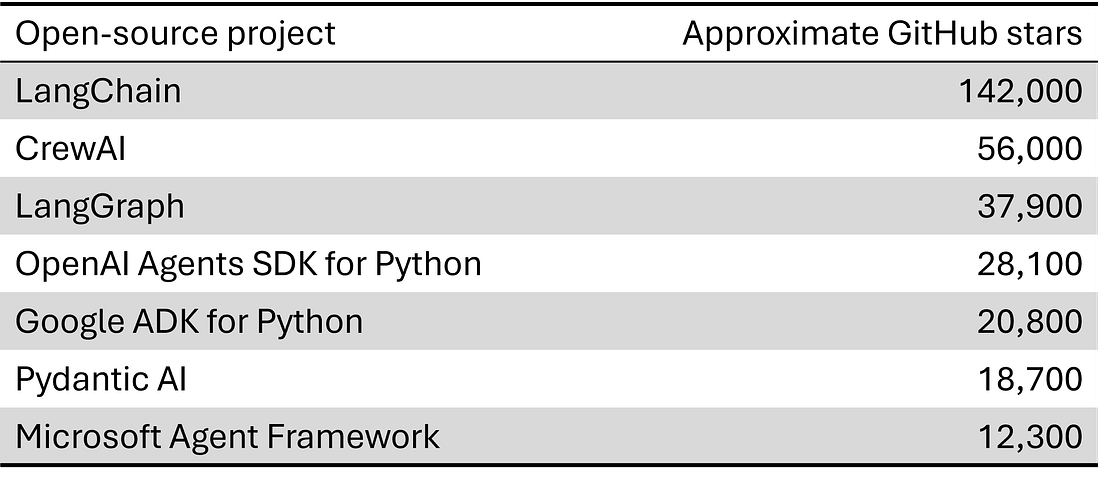
This figure indicates developer interest, not enterprise market share. Stars do not tell us how many systems are in production, how deeply a framework is used, or whether it is merely being evaluated.
But they do destroy the “everyone has abandoned LandChain/LangGraph” narrative.
The more accurate picture is:
LangChain is no longer the automatic default abstraction for every LLM application.
Developers increasingly call model APIs directly, use provider-native SDKs, adopt lightweight typed frameworks, or select only the LangChain components they need.
LangGraph remains highly relevant for durable, stateful orchestration.
It is a strong choice when the graph itself represents meaningful application logic: approvals, retries, long-running work, parallel branches, checkpoints, state transitions, and recovery.
It becomes excessive when the system is really:
Call model → invoke tool → inspect result → repeatA five-step agent loop does not automatically need a graph framework.
A multi-hour regulated process with human decisions, resumability, compensating actions, and multiple system boundaries probably does.
The framework should match the control problem.
What is the industry-standard way to build an agent in 2026?
There is no single industry-standard framework.
That is the answer many people do not want — but architects need to hear.
The emerging standard is not a product.
It is a layered construction pattern:
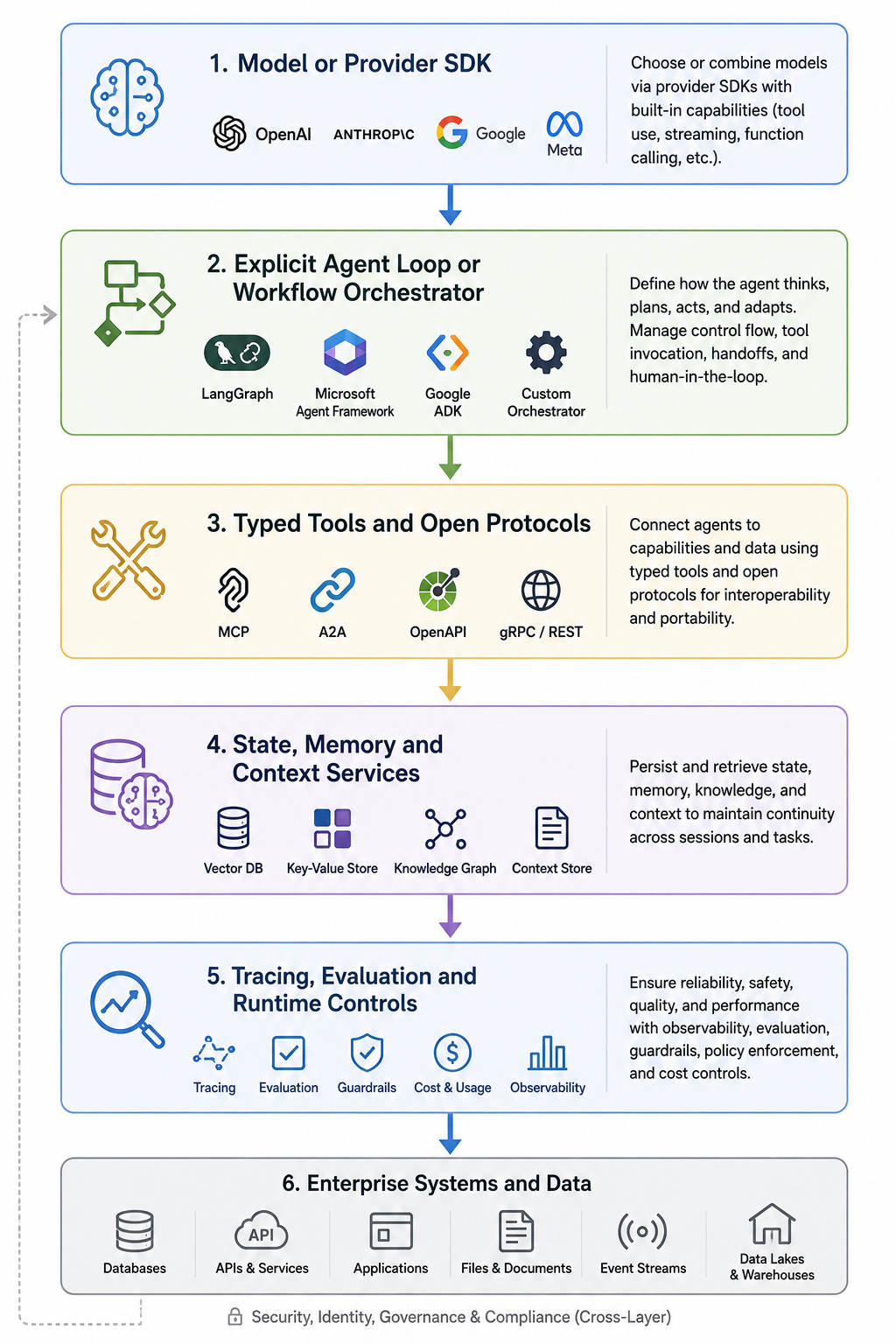
Different teams select different implementations at each layer.
A common modern stack might include:
OpenAI Agents SDK or Claude Agent SDK for model-native behavior
LangGraph, Microsoft Agent Framework, Google ADK, Pydantic AI, or ordinary code for orchestration
MCP for tool and data connectivity
A2A for selected cross-agent communication
OpenTelemetry-compatible tracing
Offline and online evaluation
A managed cloud runtime or Kubernetes
An enterprise-controlled security and governance layer
Anthropic’s own guidance captures the direction well: its work with dozens of agent teams found that the strongest implementations often relied on simple, composable patterns rather than unnecessarily complex frameworks.
The closest thing to an industry standard is therefore:
Use the thinnest abstraction that makes critical state and control explicit.
That may be a framework.
It may be a provider SDK.
It may be straightforward Python or TypeScript.
Usually, it is a combination.
The numbers reveal a more serious problem
The framework debate attracts attention because developers can see and argue about code.
The production gap is less visible.
LangChain’s 2026 survey of more than 1,300 professionals found that:
57.3% already had agents in production
Another 30.4% were actively developing agents for deployment
32% named quality as a top production barrier
Nearly 89% had implemented some form of observability
Only about 52% were running offline evaluations
That produces one of the most revealing statistics in the current agent market:
Far more organizations can trace their agents than can systematically evaluate them.
They can see what happened.
They cannot always establish whether it was correct.
And tracing is only one part of production assurance.
A production system must answer five different questions:
Observability: What happened?
Evaluation: Was the result acceptable?
Governance: Was the action permitted?
Provenance: Which evidence, identity, policy, and context produced it?
Recovery: Can the effects be contained or reversed?
Most agent platforms solve only part of that matrix.
What I see in real architecture reviews
Over the past several years, I have reviewed AI and agentic architectures across enterprises, regulated environments, and complex operational workflows.
The same pattern keeps appearing.
The client usually begins by asking whether it chose the correct framework. That is rarely the real problem. The real pain emerges several months later.
An agent works well in a demonstration but behaves differently when context grows.
A tool call succeeds technically but violates an unstated business constraint.
Two agents collaborate but lose the original user’s authorization context during delegation.
An approval exists in an application log but is no longer bound to the data or action it authorized.
A retry executes the same side effect twice.
A flawed agent conclusion is written into long-term memory and quietly influences future decisions.
A monitoring system records every request but cannot explain which policy permitted a consequential action.
A model or framework upgrade changes tool-selection behavior, and no regression suite detects it until users do.
A platform provides “human in the loop,” but no one has defined what the human is accountable for reviewing.
And when an incident occurs, the team discovers it has no compensating transaction, no clean rollback, and no complete evidence chain.
Those are not prompt problems. They are not model problems.
Most are not framework problems.
They are Agentic Engineering problems.
Orlando Parish’s enterprise framework analysis reaches the same architectural conclusion: runtimes, security systems, governance tools, protocols, and observability platforms may each operate successfully in isolation while trust disappears at their integration boundaries.
That is the part of the framework conversation that developer Twitter usually misses.
Every popular approach solves a different slice
1. Provider-native SDKs
OpenAI Agents SDK and Claude Agent SDK provide the fastest access to provider-specific agent capabilities.
Use them when model-native tool use, coding, research, sandboxing, or long-horizon execution is central.
Their weakness is not capability. It is coupling.
The more application behavior you embed in a provider’s sessions, tools, memory, traces, permissions, and runtime, the more difficult it becomes to replace the provider later.
2. LangGraph and graph-oriented orchestration
Use graph orchestration when state transitions are important enough to model explicitly.
LangGraph is particularly useful for:
Long-running execution
Human approvals
Checkpointing
Conditional routing
Resumption after failure
Stateful multi-agent coordination
Workflows that must be inspected and modified while running
Do not use it merely because the application contains an LLM.
3. Pydantic AI and typed application frameworks
Pydantic AI is attractive to teams that want agents to behave like well-engineered software services.
Typed dependencies, structured outputs, validation, and conventional Python application patterns reduce the boundary between AI development and normal backend engineering.
That is often a better fit than a large orchestration framework for bounded, API-based agents.
4. CrewAI and role-oriented systems
CrewAI remains popular because roles, tasks, crews, and flows map naturally to how people describe collaborative work.
It is effective for rapid multi-agent design, research, content, analysis, and business-process automation. But a role is not an authority model.
Giving an agent the backstory “senior financial analyst” does not define:
What data it may access
Which transactions it may initiate
How much money it may move
When approval is mandatory
What evidence it must retain
Personas organize behavior. Production systems require enforceable authority.
5. Microsoft Agent Framework and Google ADK
These frameworks are increasingly compelling for organizations aligned with their respective enterprise ecosystems.
They combine code-first development with orchestration, cloud runtimes, identity integration, observability, and managed services.
They can shorten the path to production dramatically.
They also reinforce an important architectural lesson: framework selection is increasingly inseparable from cloud, identity, data, and operating-model choices.
6. Low-code platforms and managed agent builders
n8n, Relevance AI, cloud agent builders, and visual workflow products can be excellent for bounded business automation.
They are often the correct choice when:
The workflow is standardized
Risk is limited
Speed is critical
Business users need visibility
The process primarily coordinates existing systems
Problems arise when a low-code workflow quietly becomes a strategic, cross-system decision platform whose state, policies, and recovery mechanisms cannot be expressed cleanly through the visual abstraction.
The first ten nodes feel empowering. The hundredth node often feels like archaeology.
Why Vanilla Agentic AI is emerging
Vanilla Agentic AI is often misunderstood as “do not use frameworks.”
That is not what it means.
Vanilla Agentic AI is a vendor-neutral architecture and development approach that uses models, APIs, enterprise systems, open protocols, code, and engineered runtime controls while keeping proprietary platforms optional, modular, and replaceable.
A vanilla architecture may use LangGraph. It may use OpenAI Agents SDK. It may use Claude, Microsoft Agent Framework, Google ADK, Databricks, AWS, n8n, or several of them.
The distinction is not what components are present.
The distinction is who owns the control architecture.
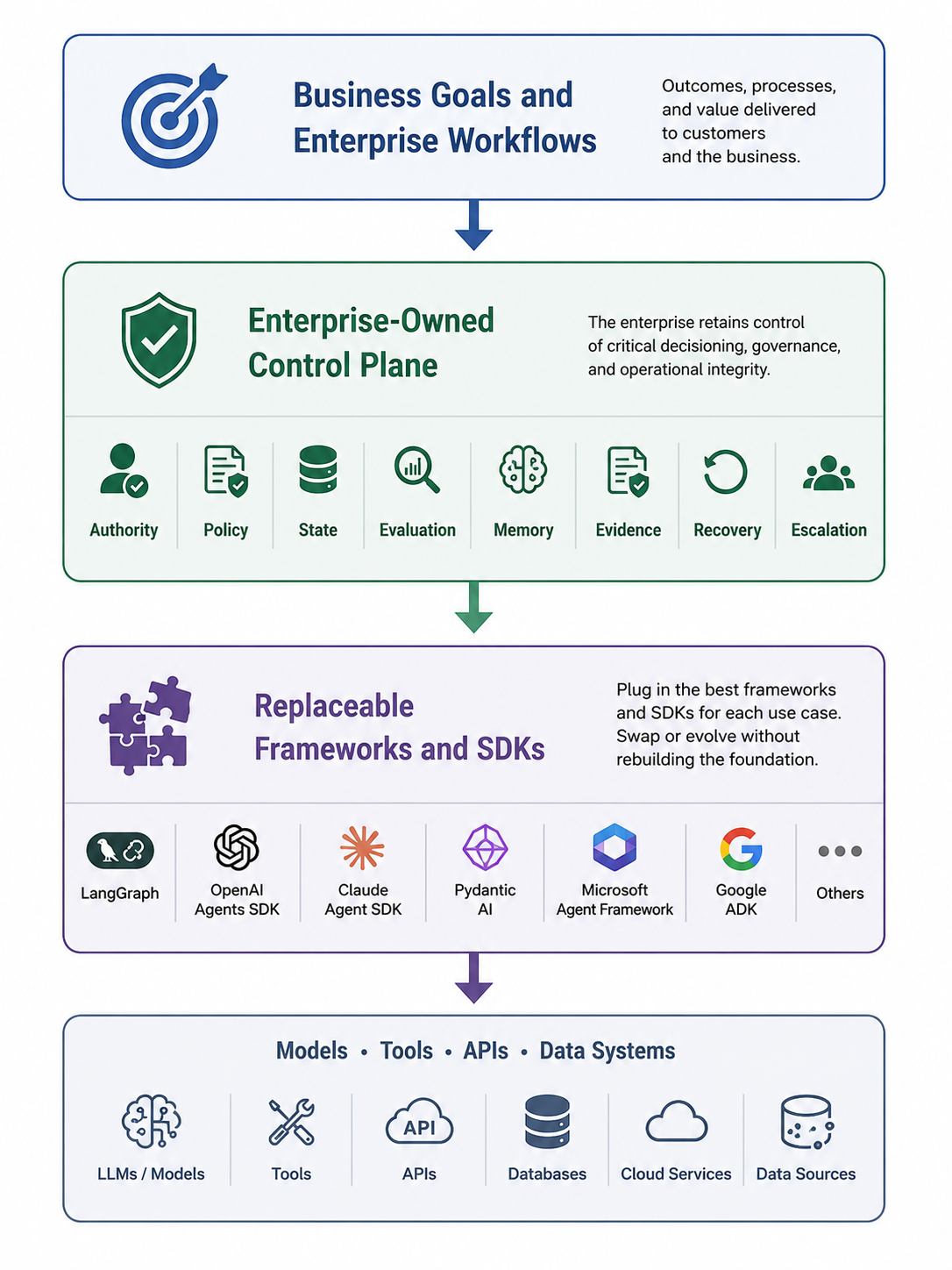
The enterprise retains control over:
Delegated authority
Autonomy boundaries
Tool-use policy
Context assembly
Memory governance
Evaluation contracts
Evidence requirements
Human escalation
Failure containment
Recovery and rollback
Production-readiness criteria
Frameworks provide leverage beneath that layer. They do not define it.
But vanilla alone can become custom chaos
There is a legitimate objection.
If every team builds its own agent loop, tool wrappers, memory store, retry model, policy checks, and tracing format, the organization has not escaped platform complexity.
It has recreated it badly.
That is why Vanilla Agentic AI requires a shared engineering discipline.
This is the role of the Agentic Engineering Body of Practices — AEBOP™.
AEBOP defines production and enterprise-grade practices for designing, building, operating, and governing agentic systems. Its public standard organizes the discipline through six core practice domains and a six-level maturity model focused on reliability, accountability, reversibility, and scalable operation.
The relationship is simple:
Vanilla determines what the enterprise should own.
AEBOP determines how that capability should be engineered.
Vanilla protects architectural independence.
AEBOP prevents that independence from becoming improvisation.
Why Vanilla + AEBOP is the strongest production approach
For a lightweight internal assistant, Vanilla + AEBOP may be more discipline than the workflow requires.
Use the managed builder. Prove the value. Do not overengineer a disposable tool.
But for an agent that is strategic, cross-system, regulated, customer-facing, long-running, or expensive to fail, Vanilla + AEBOP is the most effective pattern I have found.
It allows teams to use the best framework for each problem while enforcing a consistent engineering model across all of them.
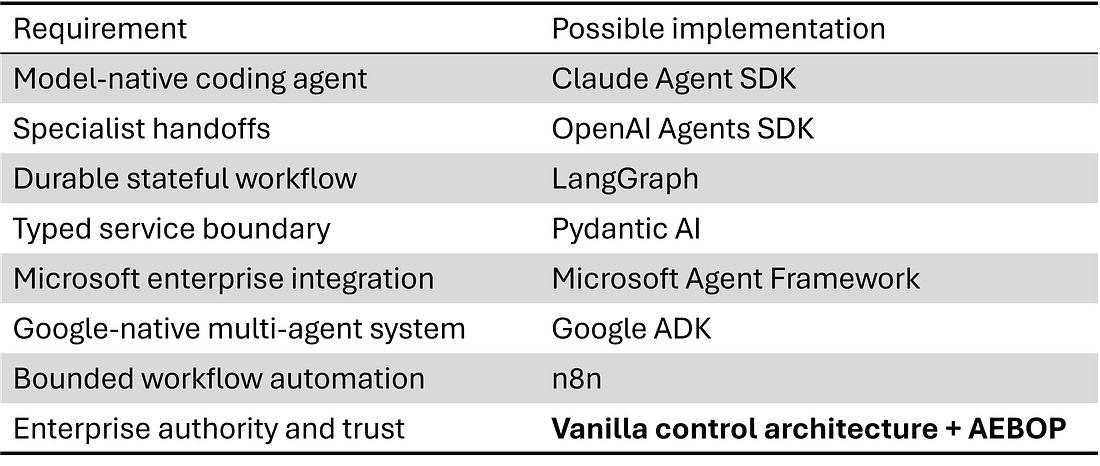
This avoids two equally dangerous extremes:
Platform absolutism: “The vendor will solve everything.”
Custom-code romanticism: “We will write everything ourselves.”
The better approach is selective ownership:
Buy acceleration.
Rent commodity capabilities.
Build differentiated controls.
Keep frameworks replaceable.
Own authority, evidence, and recovery.
The framework is becoming less important — and more important
That sounds contradictory. It is not.
The framework matters because it shapes how developers model state, tools, workflows, failures, and collaboration.
But it matters less as a permanent strategic commitment because frameworks are evolving too quickly to become the foundation of an enterprise operating model.
LangChain was the default conversation in 2023.
LangGraph dominated orchestration discussions in 2024.
Provider-native SDKs surged in 2025.
By 2026, cloud runtimes, agent harnesses, MCP, A2A, portable skills, and enterprise control planes are redefining the stack again.
The framework landscape will change.
Your production obligations will not.
You will still need to know:
Who authorized the action?
What context did the agent use?
Which policy permitted it?
Which tool produced the effect?
Was the output evaluated?
Can the decision be reconstructed?
Can the action be reversed?
Who is accountable when it fails?
No framework can answer those questions for the enterprise unless the enterprise first defines the answers.
The real industry standard
So, what is the industry-standard way to build agents in July 2026?
It is not LangChain.
It is not LangGraph.
It is not OpenAI, Claude, CrewAI, Microsoft, Google, AWS, or a visual builder.
The emerging standard is architectural:
Use direct APIs or provider SDKs where they create real leverage.
Use explicit orchestration where state and recovery justify it.
Use open protocols for replaceable tools and integrations.
Keep deterministic business controls outside model reasoning.
Treat tracing, evaluation, governance, provenance, and recovery as separate production requirements.
Retain enterprise ownership of authority, context, evidence, and failure response.
Apply a shared engineering discipline across every framework.
That is the logic behind: Vanilla Agentic AI + AEBOP
LangChain is not dead.
LangGraph is not dead.
Frameworks are not dead.
Framework-first architecture is.
The winning teams will not be those that predict which framework dominates 2028.
They will be the teams that can replace their 2026 framework without losing their business logic, institutional knowledge, runtime controls, evaluation evidence, or ability to operate.
Your framework is scaffolding.
Your control architecture is the building.
AEBOP is the building code.
Free AEI Newsletters
Expert insights and updates on Agentic Engineering—delivered straight to your inbox.