- May 3
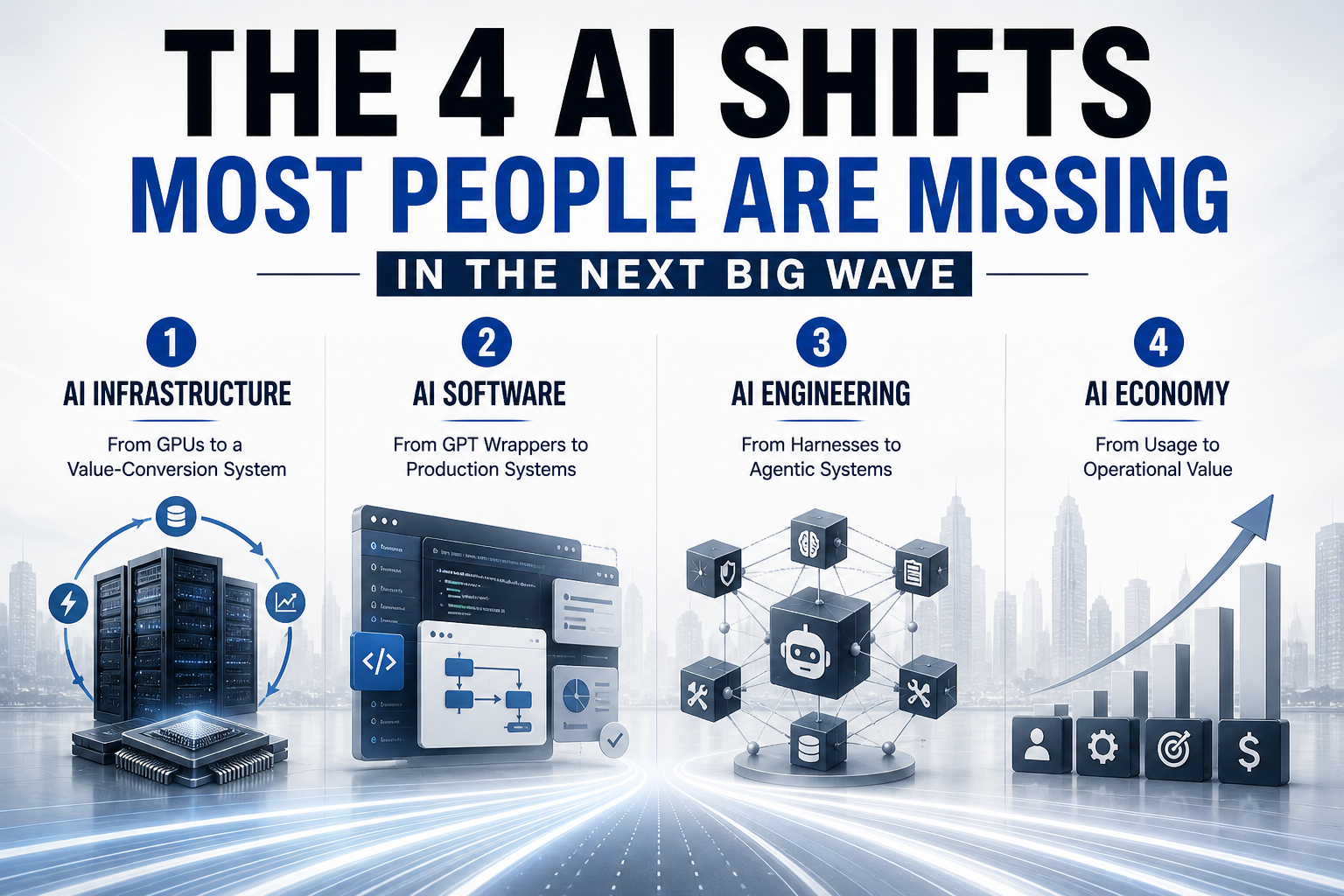
The 4 AI Shifts Most People Are Missing in the Next Big Wave
Everyone Is Watching the Wrong Race
The AI industry may be winning the wrong race.
Every week, the market gets a new signal that looks like progress. Another billion-dollar data center. Another GPU shortage. Another model benchmark. Another token price cut. Another agent demo. Another copilot rollout. Another enterprise claiming thousands of employees are now “using AI.”
The scoreboard is everywhere, and it is addictive because it gives the AI boom a simple story: more compute, better models, cheaper tokens, faster adoption, bigger impact.
But what if that story is incomplete?
What if the most important question in AI is no longer how much intelligence we can produce, how cheaply we can serve it, or how quickly people can use it?
What if the real question is whether any of it can be converted into durable economic value?
That is where the current AI boom starts to look more complicated. The industry has made extraordinary progress at expanding AI capacity. It has made intelligence cheaper, faster, more accessible, and more impressive. But many organizations are still struggling with the harder problem:
turning that capability into systems that can operate inside real workflows, under real constraints, with real accountability.
This is the hidden bottleneck.
Compute is not enough. Models are not enough. Tokens are not enough. Copilots are not enough. Agents are not enough. Even adoption is not enough.
The next wave of AI will be defined by something deeper:
the ability to connect all of these pieces into reliable, governed, outcome-producing systems.
That is a very different race from the one most people are watching.
The visible race is about AI capacity and activity. The hidden race is about AI conversion. Who can convert compute into intelligence production? Who can convert models into software systems? Who can convert agent demos into governed enterprise workflows? Who can convert token usage into measurable business value?
That hidden race is now becoming the real race.
And it may decide who wins the next decade of AI.
The Two Waves of AI Value
The hidden race in AI is not just a technology race. It is a value-conversion race.
Every major technology wave eventually reaches this point. The first phase proves what the technology can do. The second phase proves what the technology can change. The first creates excitement because the capability feels new. The second creates durable value because the capability becomes embedded into how work, markets, and organizations actually operate.
AI is reaching that point now.
The first wave of generative AI value was built around capability. That made sense. For the first time, machines could write, code, summarize, reason, search, generate images, analyze documents, understand language, and interact with people in ways that felt qualitatively different from traditional software. The breakthrough was so large that capability itself became the market story. Every new model release expanded the imagination of what AI might do next.
So the first AI value scoreboard was built around visible capability. More compute meant more intelligence. Better benchmarks meant better models. Cheaper tokens meant broader usage. Larger context windows meant more powerful applications. More copilots meant faster adoption. More pilots meant faster transformation.
For a while, that logic worked because the industry was still discovering the frontier. The main question was simple: what can AI do?
But frontiers eventually become operating environments. That is when the rules change.
The market is now entering a more demanding phase. The question is no longer whether AI can do impressive things in controlled settings. It can. The harder question is whether those capabilities can survive the operating conditions of real organizations: fragmented workflows, legacy systems, messy data, security policies, compliance constraints, budget limits, approval chains, exception paths, customer obligations, audit requirements, and human accountability.
That is where the first wave starts to strain.
A powerful model does not automatically become a reliable workflow. A cheaper token does not automatically become business ROI. A viral demo does not automatically become a production system. A copilot does not automatically redesign how work gets done. An agent does not automatically become safe, governed, observable, or accountable.
This is the transition most people are missing.
The first wave made AI impressive. The second wave must make AI operational.
I call this next phase the Operational Intelligence Economy: an economy where value comes not from isolated AI capability, but from the ability to embed intelligence into real systems of work.
In the first wave, the central question was: What can AI do?
In the second wave, the central question becomes: What can AI reliably change?
That difference sounds subtle, but it changes the entire AI value chain.
The first wave rewarded intelligence in isolation. The second wave rewards intelligence in operation: connected to workflows, tools, data, permissions, controls, governance, feedback loops, and measurable outcomes.
The first wave measured performance, usage, adoption, and excitement. The second wave will measure reliability, value creation, risk reduction, cycle-time compression, governance maturity, and trust.
That is why the next AI race will not be contained in one model release, one benchmark, one agent demo, or one token price cut. It is moving through every layer of AI value creation.
Infrastructure is shifting from raw compute to intelligence production capacity.
Software is shifting from model wrappers to agentic work systems.
Engineering is shifting from harnessing model behavior to designing, operating, and governing systems with delegated machine authority.
Economics is shifting from token consumption to measurable business outcomes.
The first wave made AI powerful.
The second wave will decide who can turn that power into production-grade value.
And that is where the four deepest shifts in AI are now becoming visible.
Signal 1: AI Infrastructure Is Moving from GPUs to a Value-Conversion System
The first AI infrastructure bottleneck was easy to see: GPUs.
For the first wave, that made sense. The modern AI boom was built on accelerated compute. More GPUs meant more training capacity, more inference capacity, more tokens served, and more AI capability available to the market. So the infrastructure story became almost synonymous with the GPU race.
But the market is now sending a broader signal.
The AI trade is spreading across the infrastructure stack: AMD in accelerators and data-center processors, Intel in CPUs, Micron in high-bandwidth memory, SanDisk, Western Digital, and Seagate in storage, Lumentum and Coherent in optical networking, and Vertiv, Schneider Electric, and Dover in power, cooling, and data-center components. This is not an investment thesis. It is a systems signal.
The market is discovering that AI value is not constrained by one component. It is constrained by the slowest layer in the value stream.
The recent data makes the pattern visible. Micron forecast quarterly revenue above Wall Street expectations in March 2026, citing booming demand for memory chips used in AI systems and tighter supply. Seagate forecast fourth-quarter revenue of about $3.45 billion, above analyst estimates of $3.16 billion, as AI data-center demand powered storage spending. Western Digital forecast stronger-than-expected quarterly revenue after third-quarter revenue rose 45% year over year to $3.34 billion. SanDisk joined the same storage wave, with Reuters reporting that enterprise spending on AI data-center storage remained strong.
The bottleneck is also moving into the network. Nvidia announced plans to invest $2 billion each in Lumentum and Coherent to strengthen photonic technologies for AI data centers, including optical networking and laser technologies needed to move data faster across large AI systems. That is a telling move: when AI systems scale, the problem is not only how fast chips can compute, but how fast data can move between them.
Power and cooling are becoming part of the same story. Schneider Electric beat first-quarter revenue expectations as AI data-center demand lifted sales of power equipment, server racks, and cooling systems. Reuters also reported that hyperscalers plan to spend more than $600 billion on AI-related infrastructure this year. Dover raised its 2026 profit outlook on strong demand for AI data-center components, including thermal connectors for liquid cooling systems.
That is the point. The GPU race is not disappearing. It is being absorbed into a larger systems race.
Production AI does not run on GPUs alone. It needs CPUs to orchestrate workloads, memory to feed accelerators, storage to preserve and retrieve data, networking and optics to move information across clusters, power to support density, cooling to preserve reliability, and software to route, monitor, secure, and optimize the whole stack.
The first wave treated infrastructure as compute capacity.
The second wave treats infrastructure as a value-conversion system.
A GPU cluster creates the possibility of intelligence. A full infrastructure system converts that possibility into usable intelligence. If memory bandwidth is constrained, the system slows. If networking is weak, distributed AI becomes inefficient. If storage cannot keep up, data becomes a bottleneck. If power and cooling fail, density cannot scale. If observability and governance are missing, production deployment becomes fragile.
That is why the infrastructure question is changing.
It is no longer only: How many GPUs do we have?
It is becoming: Where is the bottleneck in the AI value stream?
The answer may be compute. But it may also be memory, CPU, networking, storage, power, cooling, inference orchestration, data movement, reliability, cost, or governance.
This is the systems shift at the infrastructure layer. The stock-market frenzy across AI subsectors is noisy, and some of it may prove overheated. But underneath the noise is a real structural signal:
AI infrastructure value is migrating from isolated component scarcity to system-level throughput, reliability, and conversion.
In the first wave, infrastructure meant access to compute.
In the second wave, infrastructure means the ability to turn compute into reliable, efficient, governed, and economically useful intelligence.
Signal 2: AI Software Is Moving from GPT Wrappers to Production Systems
The first wave of AI software was dominated by GPT wrappers.
That was not a criticism at the time. It was the natural starting point. Take a powerful model, wrap it with a user interface, connect it to a narrow workflow, and give users a faster way to write, summarize, search, code, draft, analyze, or answer questions. For many use cases, that was genuinely useful. It turned raw model capability into visible product experience.
But GPT wrappers were never the final architecture.
They were the first translation layer between foundation models and users. They proved that AI could be embedded into software. They did not prove that AI could reliably operate inside the enterprise.
That distinction now matters.
A GPT wrapper can generate an answer. A production AI system must complete work. It must retrieve the right context, call the right tools, respect permissions, coordinate with existing systems, manage exceptions, escalate uncertainty, produce evidence, and leave behind an auditable trail. It must work not only in the clean conditions of a demo, but in the messy conditions of a real business.
This is why AI software is moving through a second stage: from single-agent applications to multi-agent work systems.
A single agent can handle a bounded task. A multi-agent system can divide work across specialized agents: one agent gathers context, another checks policy, another prepares an action, another validates output, another monitors risk, and another hands control back to a human. Gartner’s 2026 strategic technology trends include multiagent systems and AI-native development platforms, reflecting the industry’s move toward orchestrated intelligent systems rather than isolated AI features.
But even multi-agent architecture is not enough by itself.
The real frontier is enterprise system integration. Agents must connect with CRM, ERP, data platforms, document systems, workflow engines, identity systems, security layers, compliance processes, observability tools, and human approval paths. Without that integration, agents remain impressive demos. With it, they can become production-grade systems for value creation and business impact.
This is why the software market is changing shape.
Google’s Gemini Enterprise Agent Platform is not positioned as a simple chatbot builder. Google describes it as a platform to build, scale, govern, and optimize agents, bringing together model selection, agent development, integration, DevOps, orchestration, and security. That is the language of production systems, not GPT wrappers.
Adobe’s Firefly AI Assistant shows the same shift from tools to outcomes. Adobe says users can describe the outcome they want while the assistant orchestrates and executes multi-step workflows across Creative Cloud apps. That is not just AI inside a design tool. It is software beginning to reorganize around intent, orchestration, and execution.
Citi’s Arc platform shows how this pattern looks in a regulated enterprise. Citi says every agent on Arc will be monitored, auditable, and governed, with visibility into what agents are doing, how they are doing it, and the value they deliver. That is the bridge from agent experimentation to enterprise operating control.
The software question is therefore changing.
It is no longer only: Can we add AI to this product?
It is becoming:
Can this software coordinate AI-driven work across real enterprise systems and create measurable business impact?
That is a much higher bar.
More AI features can create more activity. More agents can create more fragmentation. More demos can create more confidence than the system deserves. The real test is whether AI software can move from isolated capability to governed execution: connected to data, integrated with workflows, constrained by authority, monitored at runtime, evaluated continuously, and measured by outcomes.
In the first wave, AI software made existing applications smarter.
In the second wave, AI software will become the coordination layer for how work gets done.
That is the systems shift at the software layer.
Signal 3: AI Engineering Is Moving from Harnesses to Agentic Systems
The same shift is now reaching the engineering layer.
In the first wave, AI engineering was mostly organized around the model. Teams learned how to prompt it, evaluate it, retrieve context for it, fine-tune it, constrain its outputs, connect it to tools, and wrap it inside applications. That work mattered. It helped turn raw model capability into usable products.
But it was still built around a model-centric question:
How do we get the model to behave better?
That question made sense when AI was mostly generating text, code, summaries, answers, images, or recommendations. The model produced an output. The human or the application decided what to do next. The risk was real, but the system boundary was still relatively clear.
Agentic AI changes that boundary.
The moment AI moves from generating outputs to taking actions, the engineering problem becomes fundamentally different. An agent does not merely respond. It observes, plans, retrieves context, calls tools, invokes APIs, coordinates with other agents, modifies state, triggers workflows, escalates decisions, consumes resources, and affects customers, employees, partners, and operations.
That is when traditional model-centric methods start to strain.
Prompt engineering is not enough. Retrieval engineering is not enough. Evaluation harnesses are not enough. Guardrails are not enough. Even agent frameworks are not enough if they only help teams assemble tools, memory, and orchestration patterns without engineering the control architecture around action.
This is the gap between Harness Engineering and Agentic Engineering.
Harness Engineering was a necessary bridge. It gave teams a way to package prompts, tools, context, tests, workflows, and model behavior into usable AI applications. For demos, copilots, GPT wrappers, and bounded use cases, that was often enough.
But production-grade agentic systems need something deeper.
They need authority models. Runtime governance. Trust boundaries. State management. Escalation paths. Observability. Audit evidence. Failure recovery. Security controls. Lifecycle governance. Continuous evaluation. Human-in-the-loop and human-on-the-loop operating models. They need engineers to define not only what the agent can do, but what it is allowed to do, when it must stop, when it must ask for approval, how it should recover from uncertainty, and how the organization will know whether it is creating value or risk.
That is why a new engineering discipline is emerging.
Agentic Engineering is an AI-native, system-centric engineering discipline for enterprise AI, focused on the systematic design, operation, and governance of agentic systems that reason, act, and coordinate under delegated authority, where cognition, runtime governance, and trust are engineered as first-class system properties. (From Agentic Engineering Institute)
The definition sounds formal because the shift is formal.
This is not just a better way to build chatbots. It is a new way to engineer systems that contain machine reasoning, delegated action, operational authority, and business accountability.
The difference between the old discipline and the new one is simple.
A harness asks: Can we make the model perform this task?
Agentic Engineering asks:
Can we make the system act reliably, safely, governably, and measurably inside the real world?
That is a much higher bar.
A demo can tolerate hidden assumptions. A production system cannot. A demo can impress with one successful path. A production system must handle exception paths. A demo can rely on a human to notice when something goes wrong. A production system must define authority, control risk, recover from failure, and produce evidence.
This is why the next wave of AI will create a major talent gap.
Many professionals know how to use AI. Fewer know how to engineer agentic systems. Many organizations know how to launch pilots. Fewer know how to design runtime governance, observability, trust, and operating control into systems that act.
The winners will not simply have better prompts, better tools, or better models. They will have a stronger engineering discipline.
In the first wave, AI engineering focused on making models useful.
In the second wave, Agentic Engineering will focus on making AI systems trustworthy, scalable, and accountable.
That is the systems shift at the engineering layer.
Signal 4: AI Economics Is Moving from Usage to Operational Value
The fourth shift is economic.
The first wave of generative AI created a new consumption model. Intelligence became something organizations could buy by the token, meter through APIs, embed into products, and distribute across teams. That was a major breakthrough. For the first time, advanced AI capability could be accessed almost like cloud infrastructure: on demand, scalable, programmable, and increasingly affordable.
But the token quickly became more than a pricing unit. It became a psychological unit of progress.
More tokens looked like more adoption. More API calls looked like more transformation. More copilots, more seats, more internal tools, more agents, and more prompts all created the impression that organizations were moving deeper into the AI future.
Some of that was real. Much of it was activity.
The problem is that AI activity is not the same as AI value. A company can consume millions of tokens and still fail to reduce cycle time. A team can deploy copilots across thousands of employees and still leave the operating model unchanged. A business can launch dozens of agents and still not know which workflows improved, which decisions became better, which costs disappeared, which risks were reduced, or which customers experienced better outcomes.
This is where the first wave of AI value starts to strain.
In the capability wave, the market measured what AI could generate, how many people used it, and how cheaply it could be consumed. In the Operational Intelligence Economy, the market will care about something harder: what AI can reliably change inside real systems of work.
That is the economic transition.
Tokens are a cost unit. Operational value is the value unit.
The token meter tells you how much intelligence was consumed. It does not tell you whether work was completed, decisions improved, risk was controlled, compliance evidence was produced, or business performance changed. The real value appears only when AI is connected to workflows, authority, data, tools, governance, feedback loops, and measurable outcomes.
A customer support agent is not valuable because it generates fluent responses. It is valuable if it resolves cases faster, improves accuracy, escalates correctly, reduces handle time, increases customer satisfaction, and produces evidence for quality control.
An underwriting agent is not valuable because it summarizes documents. It is valuable if it improves decision quality, detects missing evidence, follows policy, reduces cycle time, escalates exceptions, and leaves an auditable trail.
A software engineering agent is not valuable because it writes code. It is valuable if it improves delivery speed, reduces defects, strengthens test coverage, respects architecture constraints, and helps teams ship reliable systems faster.
That is why the economics of AI are moving beyond usage. The first wave monetized access to intelligence. The second wave will monetize the conversion of intelligence into operational performance.
This also explains why the AI ROI debate feels so confused. Many organizations are measuring AI consumption while hoping for business transformation. They count adoption, but not redesign. They count prompts, but not completed workflows. They count pilots, but not production impact. They count usage, but not reliability. They count excitement, but not evidence.
The new scoreboard will be harder, but more honest.
It will ask which workflows changed, which decisions improved, which costs were removed, which risks were reduced, which cycle times compressed, which controls became stronger, which outcomes became measurable, and which systems became more reliable.
The token economy will not disappear. Every production AI system still has to manage cost, latency, throughput, and usage. But the token meter will become subordinate to the operational value meter.
That is the essence of the Operational Intelligence Economy.
In the first wave, organizations paid for AI capability.
In the second wave, they will demand AI performance.
And performance will not be defined by how much intelligence a system consumes. It will be defined by what that intelligence reliably produces inside the real world.
The Real AI Moat Is Value Conversion
The four shifts point to the same conclusion: advantage in AI is moving from access to value conversion.
In the first wave, access was the scarce asset. Companies competed for compute, model access, API capacity, AI talent, copilots, agents, and lower-cost intelligence. That made sense because the market was still discovering what AI could do, and capability itself was not evenly distributed.
But as AI capability becomes more available, access alone becomes less decisive. Two organizations can use the same foundation model, consume similar tokens, deploy similar copilots, and still produce radically different results. One may end up with scattered productivity gains, impressive demos, and unclear ROI. The other may redesign a workflow, integrate AI with systems of record, define authority boundaries, govern action at runtime, measure outcomes, and improve the system after every cycle.
The difference is not simply which model they used. The difference is how well they convert AI capability into operational value.
That is the new moat in the Operational Intelligence Economy. AI value conversion is the ability to turn intelligence into reliable business performance: faster workflows, better decisions, lower risk, stronger controls, improved customer experience, reduced cost, increased revenue, and measurable evidence that the system is working.
This moat includes the workflows AI enters, the data it can trust, the context it can retrieve, the tools it can call, the authority it is granted, the controls that govern its actions, the observability that detects failure, the evaluation system that measures performance, and the human operating model that manages accountability.
This is why the winning question is changing. It is no longer enough to ask which AI capability an organization can access. The more important question is what system the organization must engineer so that AI capability becomes durable value.
Models still matter. Compute still matters. Tokens still matter. Agents still matter. But none of them creates defensible advantage by itself. The moat is the engineered system that makes AI useful, safe, scalable, governed, and economically meaningful in the real world.
Build Before the Market Catches Up
Every major technology shift creates a short window where the rules change before the language, methods, and institutions fully catch up.
AI is in that window now.
The work ahead is no longer just about experimenting with tools or tracking the next breakthrough. It is about developing the discipline to make AI reliable, governed, measurable, and useful inside real systems of work.
That discipline will not emerge from hype. It will be built by engineers, architects, product leaders, governance leaders, consultants, executives, and organizations willing to move beyond surface adoption and do the deeper work.
This is the role of the Agentic Engineering Institute, the professional body advancing Agentic Engineering for enterprise AI: defining the standards, training pathways, certification programs, governance frameworks, and operating models needed for production-grade agentic systems.
Join AEI as a member.
Partner with AEI as an organization.
The organizations that understand this shift early will not just use more AI. They will build the capability to turn AI into durable advantage.
And that may be the real dividing line of the next wave.
Free AEI Newsletters
Expert insights and updates on Agentic Engineering—delivered straight to your inbox.